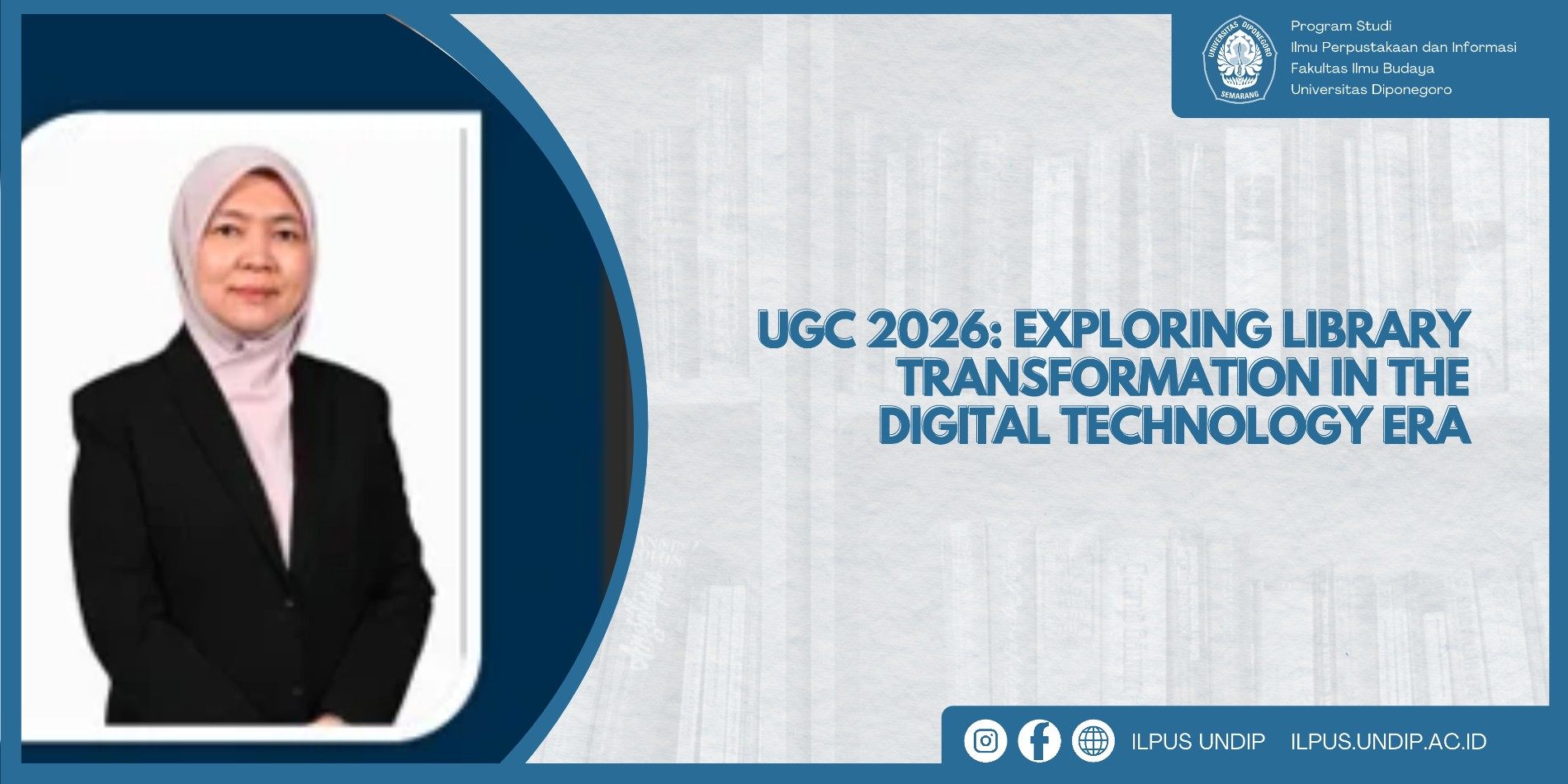

Semarang, May 25, 2026 – The Library and Information Science Major, Faculty of Humanities, Diponegoro University, hosted a public lecture on the topic “Enhancing Critical Thinking Skills in the Use of Generative AI, Fact-Checking, and Decision-Making,” presented by Dr. Hamzah Osop, a professor from the Wee Kim Wee School of Communication and Information at Nanyang Technological University.
Dr. Hamzah Osop is an expert in the fields of Data Analytics, Generative AI, and Information Retrieval. He began his academic career in 1999 at the National University of Singapore and earned his PhD from Queensland University of Technology in 2018, specializing in Computer Science. Dr. Hamzah Osop has a wealth of publications, including conference papers, journal articles, book chapters, conference proceedings, innovation projects, and more. In addition, he is also actively involved in teaching and community service, ranging from high schools and academic communities to students at various levels, including master’s, PhD, and postdoctoral candidates.
Dr. Hamzah Osop explained various applications, or key use cases, of Large Language Models (LLMs) and Generative AI. In this discussion, several key elements were highlighted: Retrieval-Augmented AI, Multimodal AI, and Code Generation, which were comprehensively analyzed to kick off the session. Dr. Hamzah Osop also presented his research on the use of GenAI, such as Gemini and ChatGPT, in an academic setting. The research results demonstrate an increased interest among students and educators in utilizing GenAI, although there remain various limitations that lead to inaccuracies, misinformation, and uncertainty regarding the sources of the generated data.
Furthermore, Dr. Hamzah Osop introduced the Nudgr App as a feature capable of strategically intervening to change student behavior, with the aim of enhancing the credibility of information and students’ critical thinking skills regarding that information. The implementation of digital nudges via the Nudgr Ap, which functions as a pop-up feature on every page of the GenAI tool, serves as a practical solution to encourage students to consistently verify and/or fact-check information generated by GenAI. In this session, Dr. Hamzah Osop detailed the structure and operation of the Nudgr App, which has been implemented and evaluated among students in the STEMM and SHAPE fields.
He also presented his research on fact-checking behaviors in the use of GenAI for learning. Additionally, Dr. Hamzah Osop moved on to the final discussion regarding the verification and retrieval of information using GenAI. He elaborated on his research, which aims to formulate practical solutions for quickly and accurately detecting the truthfulness of health information from content on social media platforms by combining LLM intelligence with existing medical knowledge bases. Thus, the information generated can be verified.
During the Q&A session, several enthusiastic participants asked Dr. Hamzah Osop questions regarding the material that had been presented. One of them, Rizqyana, asked, “To what extent does anthropomorphism affect a student’s internal motivation to conduct fact-checking?” In response, Dr. Hamzah Osop emphasized that the use of Generative AI tends to lead students to accept information without verification; therefore, an analytical system is needed that ensures transparency regarding data sources, allowing students to remain stimulated to think critically.
Author: Chelsya Rahma Cahyani