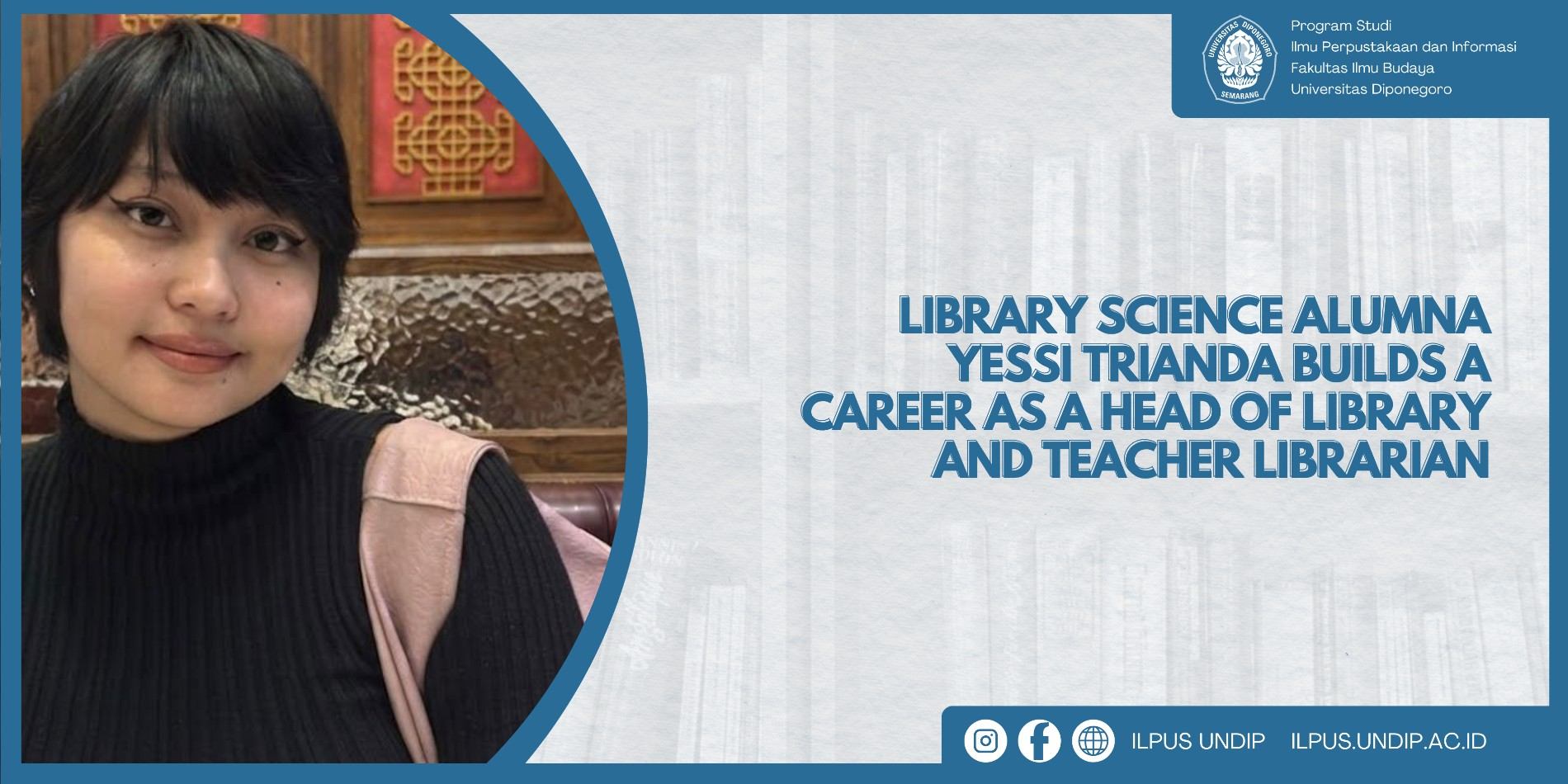
Yessi Trianda, a 2018 alumna of the Library Science Program at Universitas Diponegoro (Undip), has developed a career in education as Head of Library and Teacher Librarian at Tunas Muda School Meruya. Her professional journey demonstrates the diverse career opportunities available to Library Science graduates, particularly within school environments.
For Yessi Trianda, graduating from the Library Science Program at Universitas Diponegoro marked the beginning of a continuous journey of learning, adaptation, and professional development. As a 2018 alumna, Yessi had already begun exploring potential career paths while she was still an undergraduate student.
Her first professional opportunity came one year after graduating, when she joined Sekolah Bogor Raya. This experience became an important milestone in her career, introducing her to the school library environment as well as the International Baccalaureate (IB) curriculum.
Although she was initially unfamiliar with the implementation of international curricula in Indonesian schools, Yessi found that her education in the Library Science Program at Undip had provided her with a foundation for understanding the concept. One of the courses she took during her undergraduate studies had introduced her to international curricula, which later helped her adapt to her new professional environment.
Finding Opportunities to Grow in School Libraries
For Yessi, school libraries offer a broad and dynamic professional environment. Working in this field requires librarians not only to manage library services but also to continuously learn about different curricula and develop ways to deliver information literacy instruction according to students’ developmental levels.
After approximately two years as a teacher librarian at the IB Primary Years Programme (PYP) level, Yessi continued her career at Chung Chung Christian School in Surabaya. There, she expanded her teaching experience to the IB Middle Years Programme (MYP), serving students in Grades 7–10.
Her next career move brought her to Tzu Chi Secondary School in Jakarta, where her teaching experience continued to develop, including working with students up to Grade 11. At Tzu Chi, she was also given a new responsibility as PIC of the Secondary Learning Centre, the term used for the library in the Tzu Chi school context.
This role expanded her experience beyond librarianship into management. Yessi gained experience in managing a team, supporting librarians’ ideas and innovations, making decisions, and handling administrative responsibilities that varied across school environments.
From Information Literacy to Research Instruction
Yessi’s interest in working in a school that applies the IB curriculum continuously from kindergarten through senior high school eventually led her to Tunas Muda School Meruya. She currently serves as Head of Library and Teacher Librarian at the school, which implements the IB continuum from kindergarten through senior high school.
At Tunas Muda, Yessi has found greater opportunities to develop her interest in research instruction. She teaches Grade 12 students a range of topics, including research methods, citation, information source evaluation, and academic writing formats.
Her role becomes particularly relevant as students undertake research-based assignments within the IB curriculum. In the IB Diploma Programme (IBDP), for example, students are required to complete an Extended Essay as one of the programme’s culminating components. The assignment has characteristics similar to a mini-thesis. Yessi helps equip students with the knowledge and skills needed to complete this research project.
At the IB Middle Years Programme (MYP) level, she also teaches citation and information source evaluation using the OPVL framework, which has similarities to the TRAAP approach.
These experiences demonstrate how Library Science competencies can be integrated into teaching and learning. Knowledge of information is not limited to the ability to locate sources; it can also be developed into the ability to help students understand research methods, evaluate sources, use information appropriately, and produce academic work.
The Role of Teacher Librarians in Academic Integrity
Yessi’s career journey also highlights one form of professional development for librarians in educational settings: becoming a teacher librarian. In this role, librarians can become directly involved in the learning process by sharing knowledge with teachers and students about information literacy and the importance of becoming responsible learners.
For Yessi, the field of librarianship is broad, and school librarians have diverse professional prospects. In an educational context, teacher librarians can play an important role in supporting and maintaining academic integrity through instruction in information use, research, citation, and source evaluation.
Interestingly, many of the subjects Yessi encounters in her current professional role continue to remind her of what she learned during her Library Science studies at Undip. Her ongoing challenge is to adapt this knowledge into learning materials that are accessible to students while remaining aligned with the standards and principles of the IB curriculum.
Library Science as a Foundation for Continuous Growth
Yessi Trianda’s journey illustrates how Library Science competencies can be applied across diverse professional environments. Her experience demonstrates the connections between librarianship, information literacy, teaching, research, and management.
From her first professional experience at Sekolah Bogor Raya, through her roles as a teacher librarian at several schools, to her current position as Head of Library and Teacher Librarian at Tunas Muda School Meruya, Yessi has continued to expand her competencies through professional experience and lifelong learning.
Her story shows that a Library Science degree is not the end of a learning journey, but a foundation for continued professional development. The knowledge and skills gained during university can be further developed and adapted to meet professional needs, including taking on strategic roles in supporting learning and fostering a culture of information literacy within educational environments.